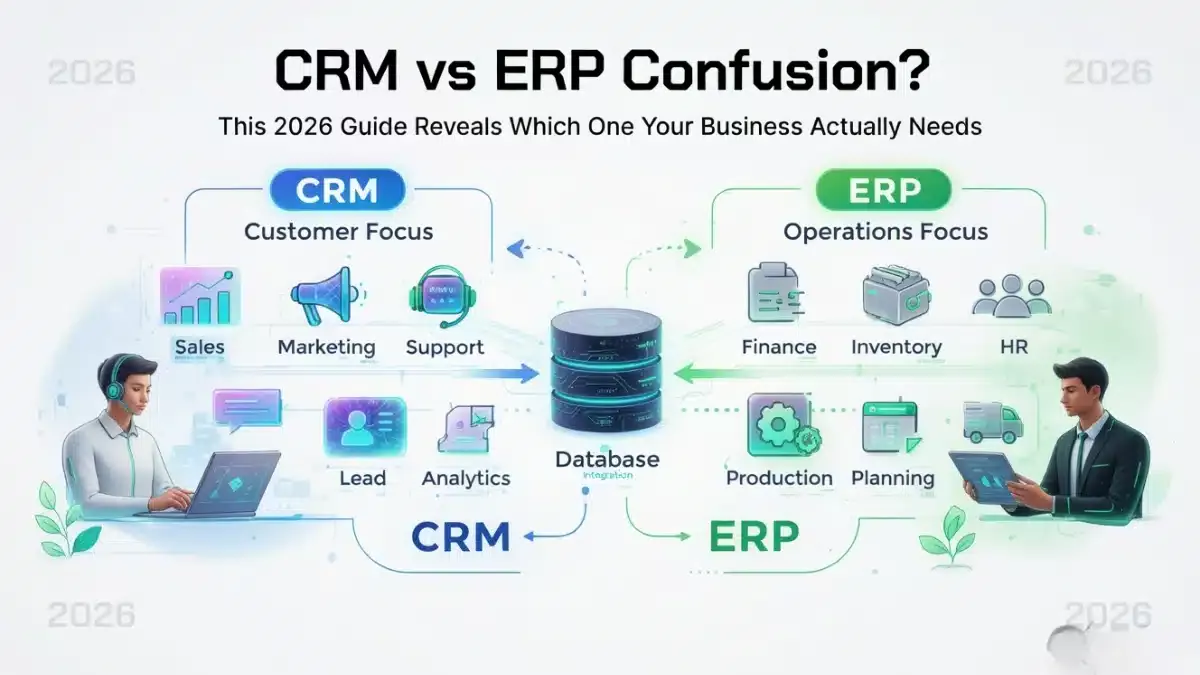
Many businesses in 2026 struggle with one big question. Should you invest in CRM or ERP? Choosing the wrong system can waste money, slow operations, and limit growth. While both tools are powerful, they serve very different purposes. Understanding the difference between CRM and ERP can help you make a smarter decision and avoid costly mistakes.
What is CRM
CRM, or Customer Relationship Management, focuses on managing customer interactions, sales, and marketing. Tools like Salesforce CRM are designed to help businesses track leads, manage customer data, and improve sales performance. CRM is mainly used by sales and marketing teams to build relationships and increase revenue.
What is ERP
ERP, or Enterprise Resource Planning, manages core business operations such as finance, inventory, HR, and supply chain.
Systems like Oracle NetSuite and Odoo ERP integrate all departments into one system, improving efficiency and control. ERP is used across the entire organization to streamline operations.
Key Differences Between CRM and ERP
| Feature | CRM | ERP |
|---|---|---|
| Main Focus | Customer relationships | Business operations |
| Users | Sales & marketing teams | Entire organization |
| Key Functions | Lead management, sales tracking | Finance, inventory, HR |
| Goal | Increase revenue | Improve efficiency |
| Data Type | Customer data | Operational data |
When Should You Choose CRM
CRM is ideal if your business is focused on sales growth and customer engagement. If you want to track leads, improve customer relationships, and boost conversions, CRM is the right choice. Businesses with strong sales teams benefit the most from CRM systems.
When Should You Choose ERP
ERP is the better option if you need to manage operations efficiently. If your business struggles with inventory, finance, or internal processes, ERP can help streamline everything into one system. It is essential for businesses dealing with complex operations.
Can You Use Both CRM and ERP
Yes, many businesses use both CRM and ERP together. CRM handles customer-facing activities, while ERP manages internal operations. Together, they provide a complete view of your business. Platforms like Microsoft Dynamics 365 combine both ERP and CRM features in one system, offering an all-in-one solution.
Which One Do You Really Need in 2026
The answer depends on your business priorities. If your focus is on increasing sales and improving customer relationships, choose CRM.
If your goal is to streamline operations and improve efficiency, ERP is the better choice. For growing businesses, using both systems can deliver the best results.
Quick Comparison Summary
- CRM focuses on customers and sales
- ERP focuses on operations and processes
- CRM boosts revenue through better relationships
- ERP improves efficiency and reduces costs
Conclusion
CRM and ERP are both essential tools, but they serve different purposes. Choosing the right one depends on your business needs and goals. Understanding their differences will help you invest wisely and build a stronger, more efficient business in 2026.
Disclaimer: This article is for informational purposes only. Features and capabilities may vary depending on software providers.